Our Approach
 Whadjuk Nyoongar Boodjar
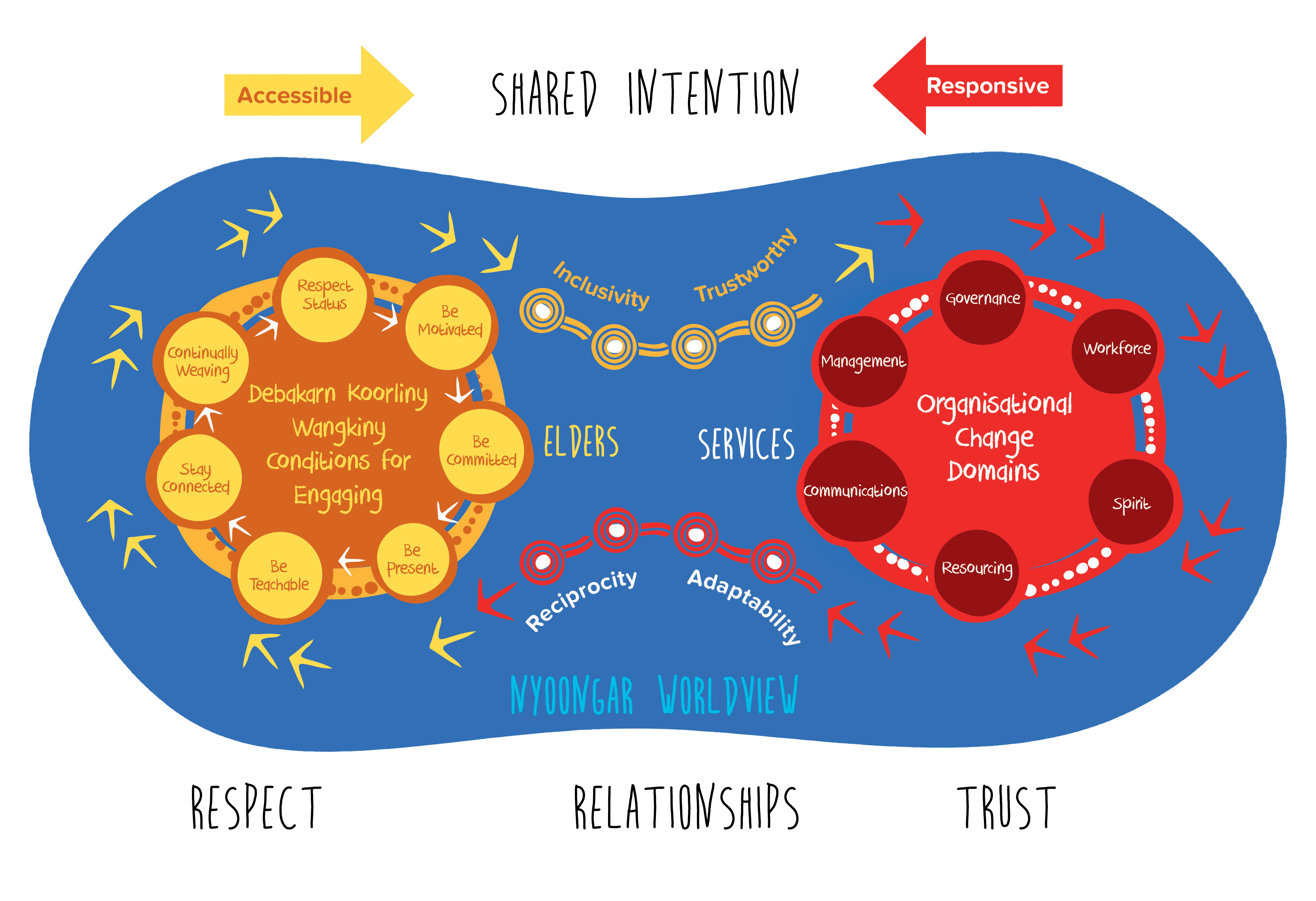
We create and facilitate relationships using the Debakarn Koorliny Wangkiny (‘Steady Walking and Talking’) conditions for working together. The ‘working together’ conditions were developed in 2015 with Nyoongar Elders, a key outcome of the Looking Forward Aboriginal Mental Health Project (2011 – 2015).
Debakarn Koorliny Wangkiny focuses on developing meaningful, purposeful relationships between Elders and service staff. The conditions ‘hold’ relationships so that services can develop: (a) inclusivity, (b) trustworthiness, (c) reciprocity and (d) adaptability.
Debakarn Koorliny Wangkiny results in a respectful shared space where new approaches, ideas, and practices are tested and validated alongside the community.
"it’s not a linear process, it is a circular process, and part of that I think is learning how to truly listen and that’s a real skill set"
- Service staff, 2018
Wardandi Nyoongar Boodja
Our Framework
Debakarn Koorliny Wangkiny forms the basis of the organisational change Framework known as Minditj Kaart Moorditj Kaart (‘from a sick head to a good head’). The Framework is founded on a Nyoongar worldview and has proven effective in bringing Elders, young people and service staff together as allies to create meaningful organisational change through co-design.
When both sides of the Framework are implemented, the shared space created leads to services having increased confidence, competence and capacity to embed new ways of working through their organisation ensuring long term change in their governance and workforce. These changes lead to more effective health outcomes for Nyoongar families experiencing mental illness and drug and alcohol concerns. The effectiveness of this Framework for other Aboriginal clan groups is being investigated through the Our Journey Our Story project.
More about the Co-ResearchersElders are central to all we do
Elders are central to all we do Elders are the custodians and wisdom holders of Aboriginal culture. They work with and guide service managers, directors and staff in:
- Understanding an Aboriginal worldview and the impact of colonisation
- Developing ways to work with the needs and aspirations of the community
- Building service capacity to work more confidently, competently and culturally securely with Aboriginal families
"I think that’s really significant to actually bring the Elders to the table of senior management, that’s huge; senior management are prepared to listen to what the Elder are saying."
- Elder, LFMF, 2017
Wardandi Nyoongar Boodja

What is on Country and Storying
What is On Country and Storying? All of our projects include an On Country and Storying. These cultural immersion activities play a key role in preparing the working together space. Both the On Country and Storying aim to disrupt the service provider’s typical ways of working, by engaging them in a deep experiential exchange resulting in a new appreciation of shared histories, shaping new possibilities and creating shared understandings about health, wellbeing and identity.
Going On Country with Elders and young people enables non-Aboriginal staff to deepen their understanding of culture, kinship and spirit. No two On Country experiences are the same. Activities may include dance, art, preparing traditional foods and walks through the bush all of which are held and weaved together by the Elders storytelling and knowledge sharing about Country. Through these activities, participants experience firsthand the deep connection Aboriginal people have with ‘boodja’ (country) and how crucial it is to their identity. This helps to better understand the central role culture has in people’s social and emotional wellbeing and how to include this in work practices.
Storying facilitates Elders, young people and service leaders to share their life stories. Through deep listening and reflection non-Aboriginal staff build connection and recognise profoundly different worldviews and lived experiences. Storying is based on the principle of reciprocity and provides the necessary foundation for trust and inclusivity. Shared storying is a powerful process which provides a conduit for deep and personal relationships, building new levels of respect; all of which is integral to the success of the co-design space.
There are now six projects that have applied and implemented the research methods of ‘Storying and On Country activities:
Looking Forward, Moving Forward
Building Bridges
Our Journey, Our Story
Kaartdijin Dordong
Ethical Decision Making
Debakarn Koorliny Wangkiny
"The experience so far has been incredible, the stories shared and knowledge passed on is invaluable. Either in a room or out ‘On Country’, hearing and working in hand with the Elders is key to sustaining the future. "
- Service provider, LFMF, 2017
Wardandi Nyoongar Boodja
Co-design explained
Co-design works to rebalance the power held by services. It provides a platform for consumers and carers to have their voices heard and valued and to meaningfully engage in the design of the services being delivered for them.
More specifically, our co-design work privileges an Aboriginal worldview in order to decolonise decision making and reorient priorities so Communities are in a position to hold services to account.
Importantly this team prides itself on co-design that is Burdiya to Burdiya (Boss to Boss). This recognises that Elders are cultural and Community leaders. The status of Elders naturally affords them a position of legitimacy and authority. The Elders bring a wealth of knowledge, wisdom and experience (both lived and professional) to shared decision making with service leaders.
"We work with bosses, so that everything can be filtered down, because it’s easier to be filtered down than trying to push it up, because it doesn’t succeed, we’ve done that for many years"
- LFMF Elder, 2018
